Thailand’s ongoing military actions against Cambodia are not merely a bilateral dispute or a border incident. They represent a grave violation of international law and international humanitarian law, principles designed to protect sovereignty, prevent war, and safeguard civilians. When these rules are ignored, it is not only Cambodia that suffers, but the credibility of the entire international legal order.
At the heart of the issue lies a clear breach of the United Nations Charter. Article 2(4) prohibits the use of force against the territorial integrity or political independence of any state. Thailand’s military operations inside Cambodian territory—whether through ground incursions, air operations, or artillery fire—constitute an unlawful use of force. Sovereignty is not conditional, nor can it be suspended by unilateral claims or political narratives. Without Cambodia’s consent or authorization from the UN Security Council, such actions are illegal under international law.
Thailand may attempt to justify its conduct by invoking security concerns or other pretexts. However, international law is explicit: allegations of crime, instability, or border tension do not authorise military invasion. Legitimate responses to cross-border challenges include diplomacy, law enforcement cooperation, or international mediation—not bombs, troops, or force. To accept such justifications would mean allowing any state to attack its neighbour simply by asserting a security excuse, undermining the foundation of peaceful coexistence.
Beyond the violation of sovereignty, Thailand’s actions raise serious concerns under international humanitarian law, particularly the Geneva Conventions. Once armed conflict begins, all parties are bound by strict rules designed to limit human suffering. Central among these is the principle of distinction, which requires armed forces to differentiate between combatants and civilians. Civilians are never lawful targets, regardless of circumstance.
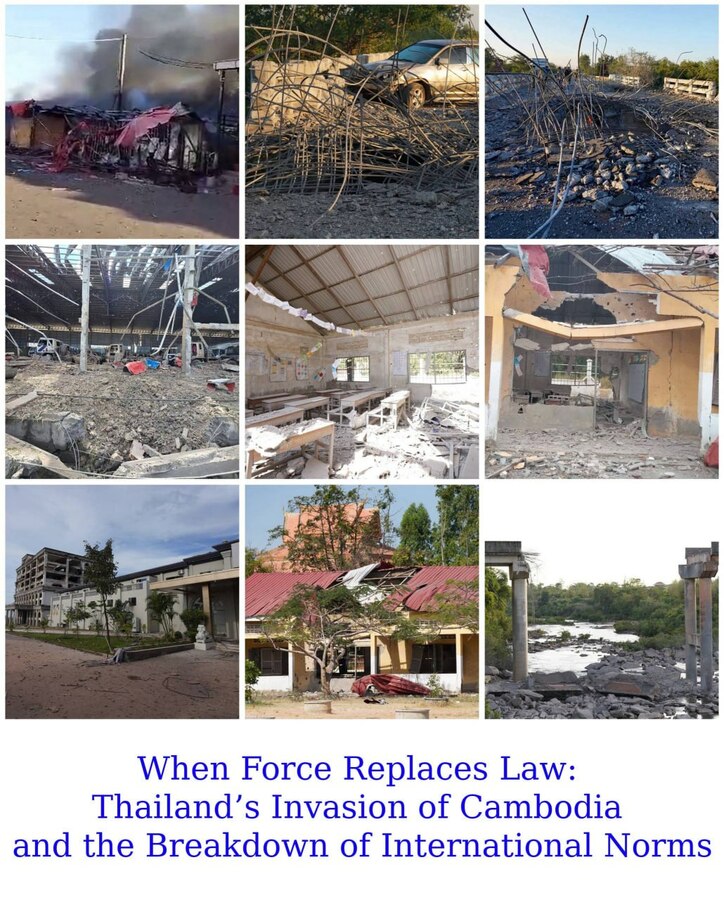
Reports of attacks affecting civilian populations and civilian infrastructure point to potential breaches of this principle. Homes, schools, public facilities, and areas where civilians seek safety are protected under international humanitarian law. Attacks on such objects—especially when they offer no clear military advantage—are prohibited. Even when military objectives exist, the principle of proportionality forbids strikes that cause excessive harm to civilians relative to any anticipated military gain.
The humanitarian consequences are equally alarming. Military operations that result in large-scale civilian displacement create additional legal and moral responsibilities. Forcing civilians to flee their homes due to fear or destruction is not a collateral issue—it is a humanitarian failure. International law demands that civilians be protected from the effects of hostilities, not driven from their communities.
In contrast, Cambodia’s position rests on the well-established right of self-defence under Article 51 of the UN Charter. When a state is subjected to armed attack, it has the right to defend its territory and population, provided its response is necessary and proportionate. Defending sovereignty is not aggression; it is a lawful act recognised by international law.
This conflict underscores a critical truth: international law cannot function selectively. States cannot claim to respect global norms while violating them when convenient. The international community must reject attempts to normalise military aggression through shifting narratives or political distractions.
Respect for sovereignty, protection of civilians, and adherence to humanitarian law are not abstract ideals. They are legal obligations. When they are breached, silence becomes complicity.
Accountability, restraint, and a return to lawful conduct are not only necessary for peace between Cambodia and Thailand, but essential for preserving the rules that protect all nations—large and small alike.
ប្រភព៖ ក្រសួងព័ត៌មាន